

Most of you know me as a pretty active person, and 2025 was the year where I really doubled down on my diet and fitness. At 44, I’m objectively in the best shape of my life, and that kind of uptrend gets pretty addictive when you’ve spent most of your adult life as a skinny-fat, alcohol-dependent, chain-smoking nerd.
So in what can only be described as a classic case of over-leveraging, I’ve been training ever harder to accelerate my growth. Recently I’ve been using exercise routines designed for one-time calisthenics *competitions* as my *daily* workout. This included muscle-ups, pull-ups, dips, toes-to-bar, etc. all rendered under strict time pressure.
When I wasn’t doing that, my training volume was often excessive: a hundred pull-ups, 200 push-ups, 400 crunches, etc. And when I wasn’t doing high volume, I was adding 20kg+ in weights to make every rep even harder.
Even during my “recovery” days, I was still aiming for 10,000 steps on the treadmill, or 1000m in the lap pool.
I’m sure the fitness professionals reading this are already shaking their heads.
All these bad decisions finally came to a head on the morning of Dec 26th. I woke up feeling like I had been hit by a truck. My head was fuzzy and I was palpitating for no reason. Because I’m an idiot, I powered through the day and still completed my competition-level workout routine while feeling like absolute shit.
When you train a lot, you hit false walls like this every now and then, where you feel utterly demotivated but really just need to press on. That’s why CrossFit and Hyrox have all those inspirational quotes in their social media about “never quitting” or doing “just one more set.” That vast majority of people need an emotional boost, otherwise they’ll never even show up.
My plan was just to make it through the day, then be so exhausted that I’d just sleep through the night and feel better when I woke up.
Unfortunately, the opposite happened.
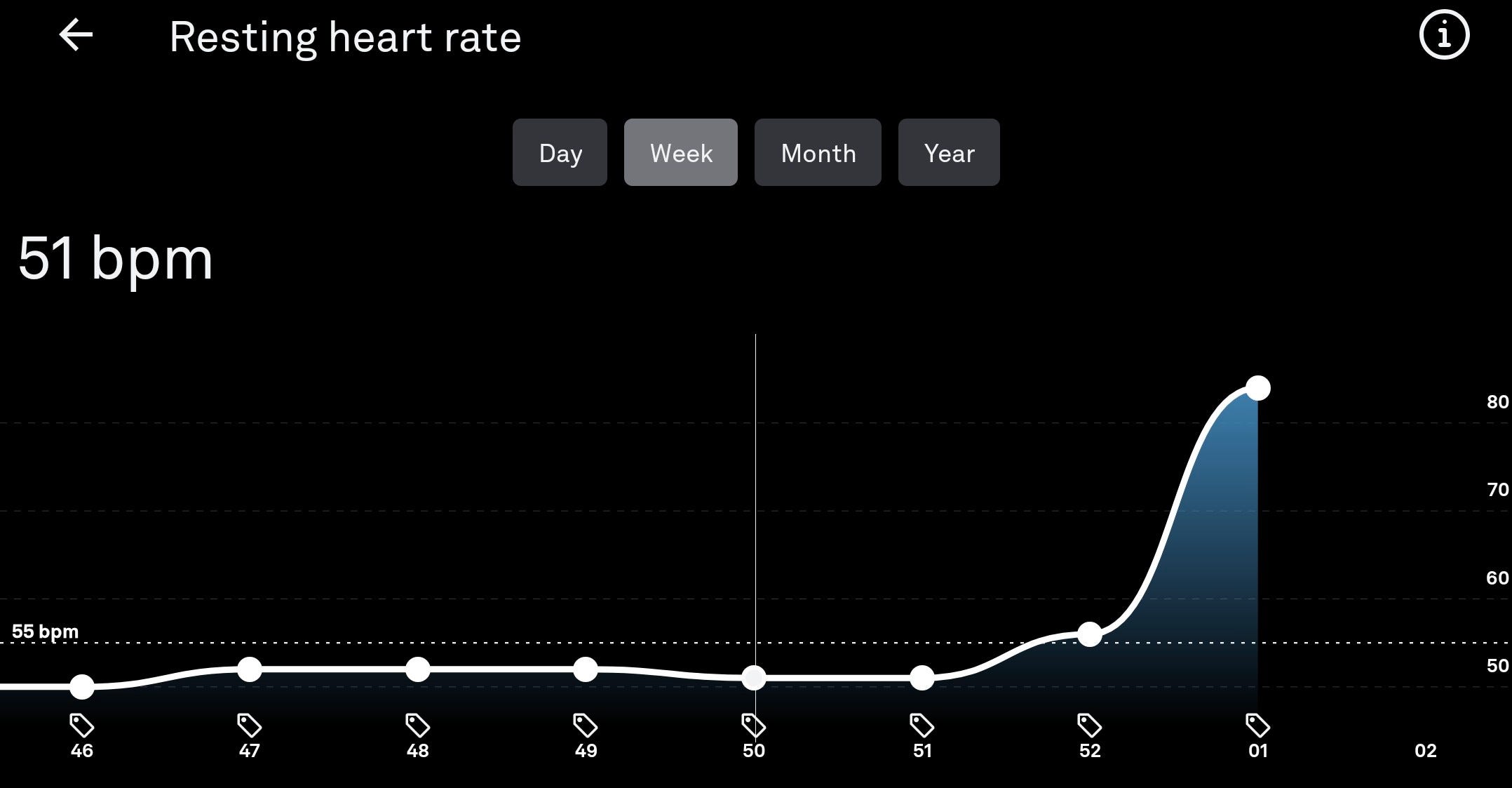
My resting heart rate that night was at an unbelievable 90bpm. (My average throughout most of this year is 50!) I tossed and turned all night, the palpitations did not subside, my headache did not go away.
When I got up the next morning, I drove myself straight to the doctor.
I was instructed to get an EKG and, just to be safe, a couple of tests for pre-diabetes and hyperthyroidism. Puzzlingly, everything came back normal … well, everything except for the fact that my heart rate was at “Zone 2” (a light workout) while I was sitting there doing absolutely nothing.
I had to get on a 22-hour flight to Europe that same evening, and my biggest worry was that I wouldn’t be cleared to fly. But my EKG reading came back as “Unclassified”, meaning that it wasn’t quite normal, but also wasn’t Atrial Fibrillation or some other life-threatening arrhythmia.
I didn’t have any chest pains, difficulty breathing, or lightheadedness. I wasn’t feeling exhausted or experiencing a substantial difference in my energy level. I felt tired because I hadn’t been sleeping well, but I wasn’t particularly stressed or emotional about anything.
My biggest stressor was really my inexplicably high heart rate and a dull headache from lack of sleep.
But that didn’t mean I wasn’t scared though.
By the time we arrived in London, I had developed a real anxiety around checking my heartbeat … which of course kept making it go even higher every time I measured it. I would unconsciously hold my breath waiting for the numbers to come in, and let out a massive sigh of disappointment when I’d see results like 105bpm.
My Oura ring was going nuts trying to make sense of my vitals – it couldn’t tell if I was ever asleep because my heart rate was never dropping. My Sleep Score was in the 40-50 range for several nights in a row, down from an annual average of 83.
I bought a medical-grade pocket EKG in London and started measuring daily. The readings kept coming back as “Unclassified,” just like at the hospital back home.
I was on vacation, so thankfully it was pretty easy to avoid all of my usual travel workout routines and focused on rest and recovery. Over the next several days, I watched my average heart rate inch downwards by an achingly slow 10 bpm per day.
Throughout this entire experience I had been feeding my data to Claude.ai for a second opinion. The diagnosis, coupled with the test results from the human doctor back in Manila, was pretty straightforward: I was over-training and under-recovering, and I had accumulated such a high recovery debt in 2025 that my body was now in autonomic overload.
So all I needed to do was rest and de-load. Don’t do anything strenuous other than walking. Wait for my resting heart rate to go back to the low-50s before attempting a gym visit. It felt weird to consciously avoid the gym, because I had spent the last 6 years rewiring my brain to seek out exercise opportunities daily.
It took 8 days to fully recover.
As I write this, my sleep score is in the low 80s, my resting heart rate is a flat 50bpm, and other than the guilt of eating too much haggis and not being able to work it off, I’m feeling pretty good again.
I returned to the gym on January 4th and tentatively pumped out a few muscle-ups to see where my energy level was at. My timing was a bit off, and I could feel myself struggling, but it was mostly all still there. My grip was strong, albeit slightly nervous.
2025 was supposed to be a breakout year for my health and fitness, and although I did indeed hit some new personal records, I guess I didn't know enough about proper recovery. As we kick off 2026, I’m going to need to be a lot more careful with my workout schedule. The new plan will enforce two days of real rest and recovery each week, and only allow a maximum of two days of heavy “competition-level” work.
Most people in my age bracket struggle to find the motivation for regular exercise, but due to my own vanity and hubris, I ended up pushing myself to the opposite extreme. I’d developed an addiction to strength-building, and this experience last week was a humbling reminder: what I should have been aiming for was balance.
Am glad you went for an early diagnosis and you’re feeling much better now. Take it easy or else you’ll have to do Tai chi exercises for people in their 70s…