

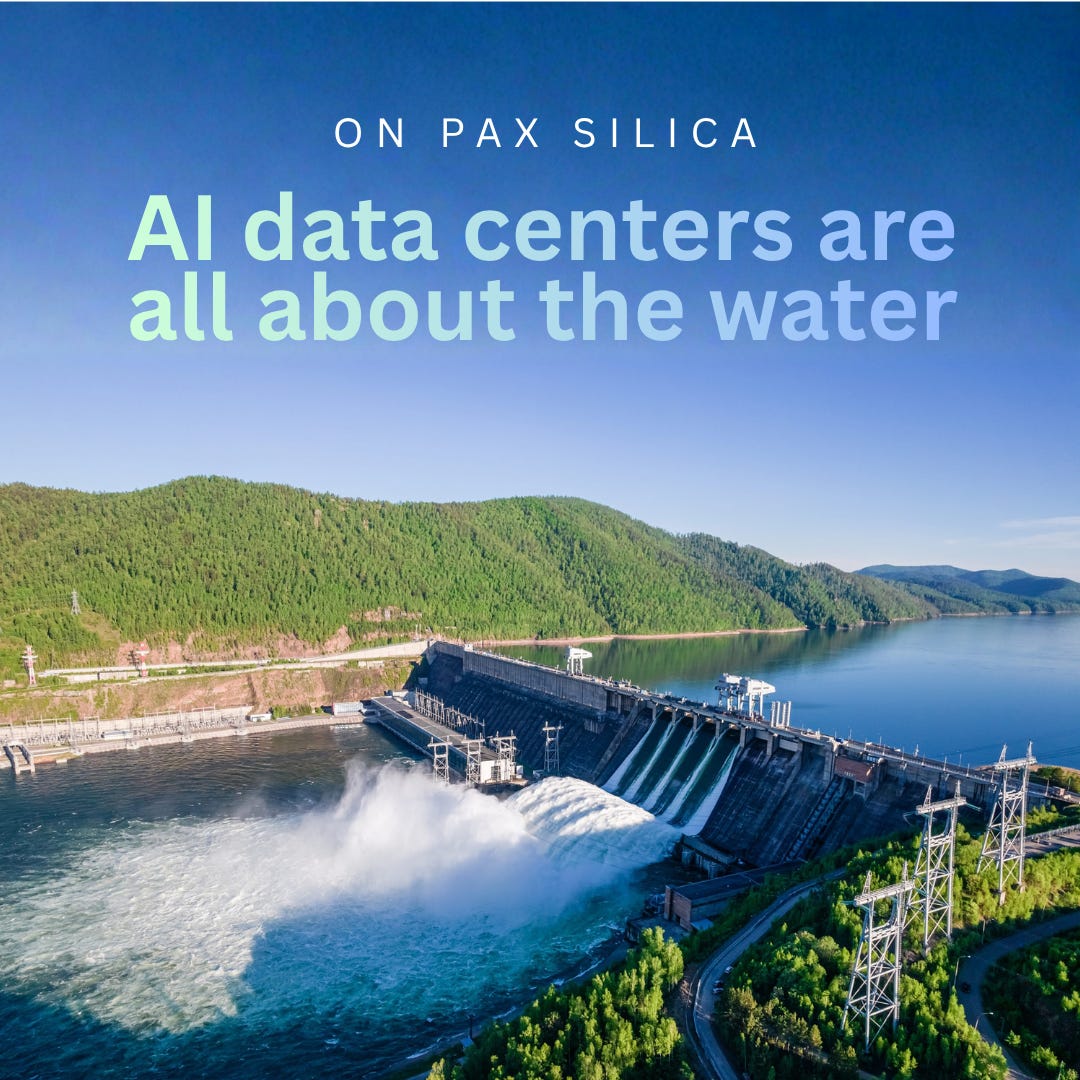
Recently there’s been conversations around Pax Silica, a globally-targeted US initiative to build AI data centers in friendly jurisdictions.
AI data centers use a lot of water, something that the Philippines really struggles with during the summer months. But precisely how much water it uses is something that people disagree on. 💧🤔
Let’s look at the data!
Sam Altman has said in interviews that 15 AI prompts will use about ONE TEASPOON of water … and considering who said it, that factoid feels like a self-serving understatement.
Meanwhile, Morgan Stanley has estimated that AI data centers will collectively use 1.4 trillion liters annually world-wide by 2030. That’s a lot of teaspoons. 🥄🥄🥄
Is 1.4 trillion liters of water a year A LOT? Well, it depends on what you’re comparing it to.
For instance, about 10% of your car’s fuel tank is ethanol, which is made from corn 🌽. Globally, we consume 118B liters of ethanol every year, and in order to produce that ethanol, we use around 300T liters of water for irrigation and bio-refinement.
So, really, if you’re interested in saving water, ethanol is nearly 300x thirstier than AI data centers, and it powers an industry that has far more pollutive effects. 🚗
But talking about stuff like global water usage is fun only because it makes dinner conversations more interesting. (To be fair, this is probably why I don’t get invited to many dinners.)
What really matters here is: can the province of Tarlac support the water requirements of this AI data center?
A 1GW data center in New Clark City would need about 15B liters of water a year, which is 2x of the city’s current water demand, and Tarlac is a notoriously under-irrigated province. About a third of its rice fields don’t have direct water supply and have to rely on pumps or rainwater.
Central Luzon as a whole has a 5T liter annual water DEFICIT.
Back in February, Maynilad pitched a 15B-peso wastewater processing system project to get New Clark City on track. And in June, the city inked a partnership with Japanese company Marubeni to upgrade its energy infrastructure. Those two deals are the closest things we currently have to a plan.
Agreements like Pax Silica are usually framed as catalysts for development, so it’s possible that the wheels will start turning faster now that we’ve made an international commitment.
But it’s worth reminding everyone that the Pax Silica agreement is actually non-binding. All it does is establish an intent to do feasibility studies over the next year, with a soft target of ground-breaking in 2028 before the Marcos administration ends.
Based on what we’ve shown above, the most likely thing those feasibility studies will uncover is that it’s just structurally impossible to host a data center of that size in New Clark City.
In the meantime, I guess it’s just fun to argue about it.